Unveiling the Magic of March’s Aquamarine

As winter loosens its grip and the world tilts toward spring, March arrives with a birthstone that perfectly captures this transitional magic: the aquamarine. With its serene, crystalline blue reminiscent of sunlit shallows and deep ocean horizons, aquamarine is more than just a beautiful gem. It is a vessel of romance, mythology, and profound symbolism, offering its wearer a tangible connection to the calming depths of the sea and sky. This captivating stone has stirred human imagination for millennia, weaving tales of mermaids, gods, and eternal love.

The romantic allure of aquamarine is deeply rooted in maritime legend. For centuries, sailors and travelers carried it as a talisman for protection over treacherous waters, believing it could calm waves and ensure a safe voyage. This association naturally evolved into a symbol of lasting love and commitment, making it a cherished jewel in betrothal rings and sentimental gifts. To give aquamarine was to promise safety, fidelity, and a love as enduring as the ocean itself. Its clear, tranquil hue evokes a sense of honest and open communication, making it an emblem of a relationship built on trust and understanding—a true romance anchored in deep, peaceful waters.

Aquamarine’s mythology stretches back to the treasure troves of gods and mythical beings. The Romans believed the gem was sacred to Neptune, god of the sea, having fallen from the jeweled boxes of sirens or washed ashore from the depths of his realm. In ancient lore, it was considered the treasure of mermaids, a stone that could capture the very essence of the ocean. Greek legends held that aquamarine was worn by Poseidon and could harness the power of the sea, offering the wearer the god’s protection and favor. These stories imbue the stone with a sense of ancient power and mystery, connecting the wearer to a timeless, mystical world beneath the waves.

Beyond myth and romance, aquamarine’s symbolism is universally resonant. Its primary associations are with tranquility, courage, and clarity. The soothing blue color is said to calm the mind and reduce stress, acting as a touchstone for serenity in turbulent times. Historically, it was believed to clear mental fog, enhance intellectual clarity, and grant the wearer the courage to speak their truth—making it a stone of both peace and fearless expression. As the color of sky and sea, it symbolizes expansiveness, purity, and the fluidity of life, encouraging a smooth flow of communication and emotional release.

For those born in March, or for anyone drawn to its ethereal beauty, aquamarine is a powerful companion. It is a gem that carries the whisper of ocean tides and the vastness of the spring sky. It invites us to embrace the calm within the storm, to communicate with heartfelt courage, and to remember the ancient, romantic mysteries that still resonate in the natural world. To wear aquamarine is to carry a piece of the sea’s soul—a timeless reminder of peace, protected love, and the enduring magic of clear, blue depths.


Expressions of Gratitude

The definition of gratitude is being glad that something has or hasn’t happened; that something or someone exists; experiencing thanks. I started practicing gratitude about more than 15 years ago.  I have refocused on it after suffering a burst aneurysm in 2013. 

Being thankful on a regular basis improves our relationships, sleep, general well-being, and health.  Science has shown that there are many benefits to being grateful, and these are just a few.  Despite being a very simple exercise, when performed on a daily basis, it can have profoundly transformative results.  The habit of identifying things for which we are grateful each day creates new neuropathways in the brain, the more we practice being grateful (or, for that matter, anything we focus on).  For the brain, this process—known as neuroplasticity—is comparable to physical exercise.

Eventually, being grateful becomes a habit, which leads to a more optimistic perspective in general, especially during difficult situations.  We can be thankful for every moment as a chance to develop, learn, and discover a new way of being in the world, but we cannot be thankful for horrible things like this pandemic.  This is resilience.

Observe the abundance of creativity, ingenuity, and kindness all around you.  We are pushing ourselves to discover new ways to thrive rather than just survive.  The question, “What do I actually need?” is becoming more and more common.  What is most crucial?  We’re talking to loved ones about our deepest emotions and recognizing what matters most in life.

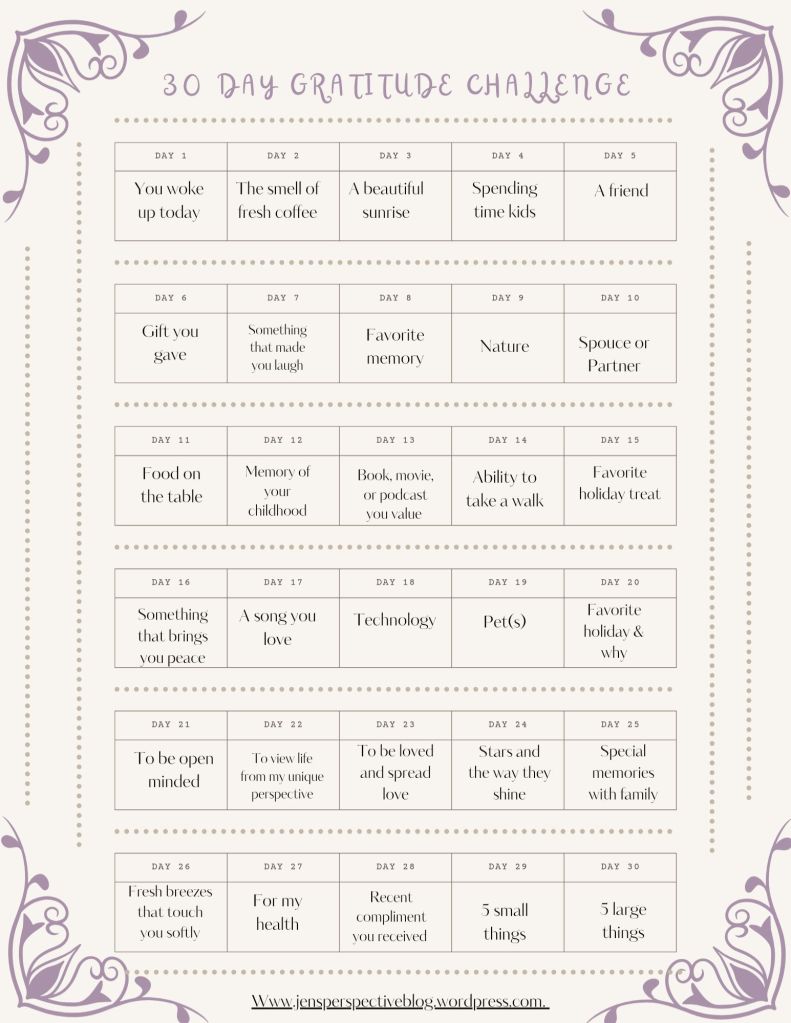
For 30 days, I want you to locate at least one item for which you are thankful every day.  A new habit takes around 30 days to form.  Don’t worry if you skip a day; just keep going.  As you write it down, acknowledge and experience the emotions it evokes in your heart.  Although you can do this at any time, it helps you sleep if you recall these things before bed.  Join me if you want to express your gratitude. Share to Social media using #Jen’sPerspectiveGratitudeChallenge .

This is my challenge

CHINESE NEW YEAR

Every year, China, along with countries around the world, ring in the Chinese New Year. This highly anticipated event is also known as the Spring Festival.

Many people are familiar with the western world’s New Year, which falls on January 1st. Because it coincides with the Gregorian calendar, it is the same date every year. The Chinese New Year coincides with the lunar calendar. On the lunar calendar, the first day of the month begins during the new moon. Because of this, the Chinese New Year falls on different dates each year. However, it does always fall between January 21 and February 21.

The traditional holiday period for the Spring Festival lasts 23 days. The public holiday is celebrated for 7 days. This means those in Mainland China who celebrate the Chinese New Year get 7 days off from work.
Another feature of the Chinese New Year is each year is always associated with an animal. The animals always go in a certain order and repeat every 12 years. These animals include:

  • Tiger
  • Rabbit
  • Dragon
  • Snake
  • Horse
  • Goat
  • Monkey
  • Rooster
  • Dog
  • Pig
  • Rat
  • Ox

2024 will be the year of the Dragon. According to the Buddhist religion, Buddha promised gifts to all the animals who would come to honor him. Only these 12 animals came. Some Buddhists also believe that when babies are born, they inherit characteristics from the animal of their birth year.

People all around the world celebrate this holiday. Traditional celebrations include lighting firecrackers. These firecrackers are supposed to scare off bad luck. It is also a ceremonial day to pray to gods for a good planting and harvest season. Many families host huge New Year’s Eve dinners. Children receive lucky money in red envelopes. Lantern festivals, colorful decorations, dragon dances, dumplings, desserts, and special wine are also a part of the celebration.

CHINESE NEW YEAR HISTORY

The origin of the Chinese New Year goes back to the Shang Dynasty from 1600 to 1046 BC. During this time, people held sacrificial ceremonies in honor of gods at the beginning of the year. The date of the Chinese New Year was established during the Han Dynasty from 202 BC to 220 AD. Through the years, different ways of celebrating the New Year evolved. In 1949, the Chinese New Year was renamed the Spring Festival.

HOW TO OBSERVE #ChineseNewYear

Just as there are ways to observe the day, there are also many things you aren’t supposed to do. The Chinese have a strong belief in good and bad luck. If you do any of these things on New Year’s Day, it will bring bad luck for the rest of the year:

  • Wash your hair
  • Eat porridge
  • Do needlework
  • Use unlucky words
  • Wash clothes
  • Sweep the floor

There are also things that should be avoided during the entire Spring Festival. These things include crying, killing, breaking dishes, wearing black or white clothes, using scissors or knives, and visiting people in the hospital.

While you celebrate, use #ChineseNewYear to share on social media.

NATIONAL LUCKY PENNY DAY

On May 23rd, National Lucky Penny Day hopes you’ll have good luck all day long.

See a penny, pick it up. All day long you’ll have good luck.

Featured in Grease

When you are out and about, look on the ground for pennies.  It just might be your lucky day!

Years ago a penny was able to buy something. (Check out National Taffy Day – to see what we used to get for a penny.) Today, due to inflation, the penny does not buy much of anything. The metal value and cost of minting pennies exceed their face value. Many nations have stopped minting equivalent value coins and efforts are being made to end the routine use of pennies in several countries including the United States.

First U.S. Penny

The United States first issued a one-cent coin produced by a private mint in 1787. Benjamin Franklin designed it. On one side, it read “Mind Your Business” and the other “We Are One.” This coin was made of 100% copper and was larger than today’s penny. It came to be known as the Fugio cent. However, the first pennies struck in a United States Mint weren’t produced until 1793, but they were also made of copper.

But why are pennies lucky? Well at one time, metals, including copper were precious material. Finding a penny was a valuable find. Sometimes finding a penny had more to do with the daily battle between good and evil. Do you only pick up a penny if it’s head side up? Superstitions carry on from generation to generation. And with some of them the rule that says if you find a penny tail side up, you should flip it over and leave it head side up for the next lucky person to find.

On a wedding day, there’s also a saying that leads people to put a penny in the bride’s shoe. It’s more likely to lead to a blister than to bring good luck in that case.

HOW TO OBSERVE #LuckyPennyDay

See how many pennies you can find. It just might be your lucky day! Use #LuckyPennyDay to post on social media.